
Brewery Silos
Ingress & egress free, built to last
Take the hassle out of storage and automate your brewing process with silos configured for brewing. Available in corrugated or smooth-wall models, stainless or powder-coated, and in custom shapes and designs, our silos help you avoid the costs and downtime of post-installation adjustments. Solve operational issues in your brewery or distillery and improve reliability with our silos' convenient features like flow-assists, level indicators, optional cooling/heating, and ABM’s proprietary leak-proof discharges. Built either in Canada or the US, our silos help you save money and avoid the added cost of tariffs.
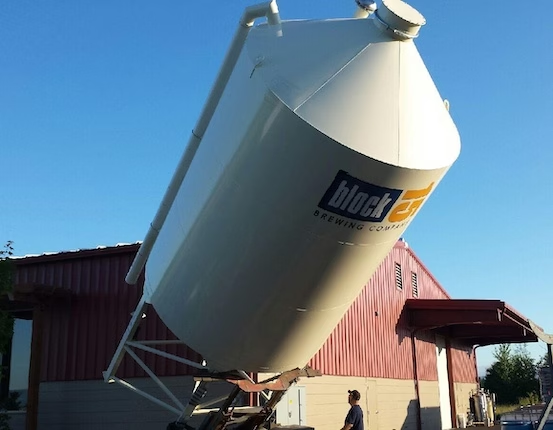
Fully Cured Powder Coating
High quality powder coating protects the silo, the malt, and the appearance of the facility.
Custom-Built
Each unit is designed for the brewery or distillery's brand, local climate, seismic area, and municipal codes for easy permitting.
Dust-Tight Discharge Gates
Our custom gates eliminate leakage, protecting grain from moisture and resisting infestation.
Single-Piece welded builds
Bolt-less and seamless interiors increase longevity and resist hang-ups and ingress of contaminants.
Our brewery silos are built with features necessary for brewers and distillers. Engineered for durability and smooth install, they can be fitted with, augers, chain-disks, or pneumatics, depending on your configuration and throughput needs. Whether you are expanding capacity or improving flow efficiency, our silos are designed to optimize space, reduce manual handling, and support consistent, high-quality production.
The Right Silos for Your Brewery and Distillery
When it comes to grain storage, the best silo is the one built for your specific operation. Whether you're facing space limitations, sensitive ingredients, or budget constraints, the right silo can be a game-changer. That’s why we offer both smooth-wall and corrugated wall silos, because either can be preferable depending on the conditions.
Corrugated-Wall Silos
Corrugated brewery silos are a good, low-cost way to step up to bulk orders, but they must be in the right climate or sheltered from it. This is because corrugated-wall silos let in more oxygen, heat, and moisture. Over time, they can also lose the inner galvanization to attrition and get grain stuck in the nooks and crannies, which reduces shelf-life of the rest of the grain in the bin.
Corrugated silos should also only be filled mechanically, which is a problem because most grain trucks use pneumatics. The fluctuating pressure from pneumatics (not to mention the expanding and contracting caused by temperature variations) causes bolts to loosen, leaks to form, and rust to arrive early. Again, leaks are especially bad for grain because they attract pests, which are nearly impossible to remove once you’ve attracted them.
Smooth-Wall Silos
Our smooth-wall silos are perfect for breweries and distilleries because they are much more hygienic and resilient. With no internal bolts or seams, these silos prevent grain hang-up, reduce exposure to moisture and oxygen, and are easier to keep clean. As opposed to other brewery silos which are welded one-piece throughout and then leak at the bottom, our custom gates are just one part of our leak-free grain systems.
Also available are flow-assist solutions, which are helpful when the dimensions of the silo are restricted and you want to maximize volume. These options include vibratory pucks and air blasts, all of which can be retrofitted if you already have a silo then ran into problems later. Standard and optional features follow.
The ABM Advantage
Made-to-order silos for breweries and distilleries can fit nearly any space, whether that means custom dimensions, materials, components, or features. Our silos come with a number of advantages for the brewery world including:
- Original leak/dust-free discharge gates (other suppliers have copied this and some actually work almost as well.)
- Level indicators and/or sight glasses
- Strategies for avoiding municipal restrictions
Our distillery and brewery silos are made in North America with high-grade steel & components and feature:
- High-quality interior and external powder coating
- Tubing legs and bracing for cleanliness and durability
- Fill pipes with radius elbows and scroll boxes for reduced product damage
- Horizontal bands for full structural support
- Vent lines to reduce dust buildup on the roof and surrounding surfaces
- Filter bags for the vent line
- Top non-venting manholes
- Enclosed auger boots for product integrity and cleanliness
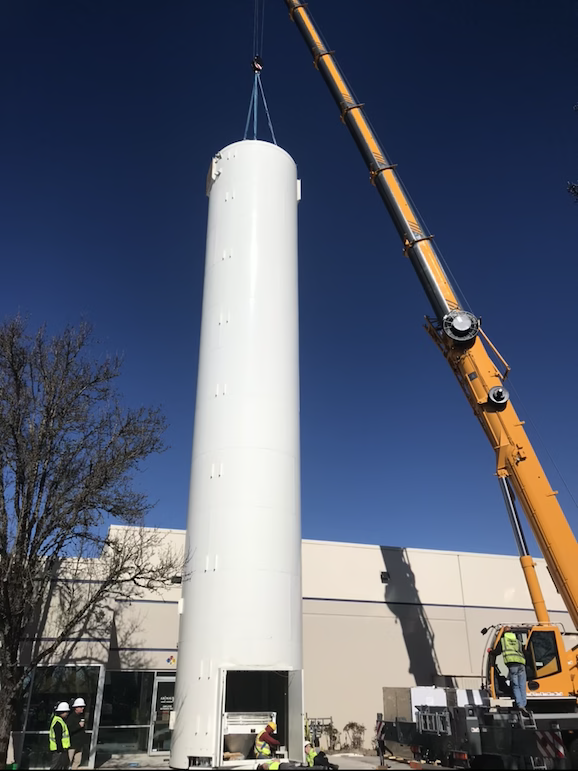
Silos are made-to-order to accommodate height or footprint restrictions.
OPTIONS:
- Dust collection
- Jacketed (for heating or cooling)
- Fall arrest systems
- Caged ladders & high-grip railing
- Flow-assists
- Vibratory
- Air
- Bottom access-hatch
- Laterally-supported foundation
- Climate control
- Jacketing
- Direct coils
- Ventilation
- Forced air
- Load Cells


F.A.Q.
When do I need a silo?
You can be 100% sure you need a silo when it will pay for itself in grain savings, which is easy to determine. To do this, get quotes from your grain supplier at the larger quantities and put them in this form https://abmequipment.com/grain-system-roi-calculator/ . This will tell you how much you will save monthly by ordering grain in bulk. If the savings are greater than your payments on a loan to finance the system, it is time for a silo. Of course we will get you the silo cost and monthly rate if you need financing.
What color should a silo be?
If freezing is your concern, use a dark color to absorb the heat of the sun and reduce energy consumption if you're using anti-freezing mechanisms.
If heat is your concern, use white to reflect the heat of the sun and extend the life of your grain. Of course, in either case we have jacketing and heating/cooling measures we can apply.
If you're in a temperate climate, use your logo and brand colors, but lean toward lighter colors. A silo draws the eye, making this very cheap advertising, and lighter colors will overall reduce the temperature of the inside of the silo and keep your grain/malt fresher for longer.
Do I need insulation, heating, or cooling?
In most climates, no. But if your area is very cold—causing freezing—or very hot—causing grain to spoil early—then yes. The first thing you want to do is insulate the silo and use appropriate colors. But for cooling, you can aerate the silo (blowing cooled air through the bottom, up through a vent in the top). For heating, you can place heating elements in the silo. However, this should be done carefully because if the element is too hot it will strip the paint.
Should I put our distillery and brewery silos on load cells?
Only if you want to: verify suppliers' deliveries, double-check your weights from your weighing system, or if the rest of your system is on load cells and you use that for automation. If any of these are the case, fill out the form below to get a quote! To learn more, go here.
When NOT to use silo load cells:
System automation: When automating a system, using a Scale Package, is much cheaper and more precise.
Inventory management: When monitoring grain levels, using a Level Indicator is much cheaper and similarly accurate, depending on the option chosen.
Will I need a permit?
Most of the time you will. A city will want to regulate you over seismic concerns, height restrictions, zones, and sometimes aesthetic taste. We will help you navigate all these waters and will provide your city with the drawings they ask for.
What is a brewery silo compared to normal ones?
Brewery silos have special configurations for the needs of brewers (and distillers). These include:
- ABM's custom leak-proof discharges (these are especially important for deterring insects and rodents for brewers and distillers).
- Removal of ladder (brewers never use them)
- Lower cost level indicators (weighted line, rotary, or flapper)
- Specific flow-assists when necessary (vibratory or air blast)
- Pneumatic fill lines
- Exclusion of explosion gates
- Stainless with screw conveyor including clearance for trucks (for spent grain)
What's the ideal cone slope?
Fresh grain silos should be sloped at least 30 degrees to ensure the grain flows smoothly. If height restrictions require the silo to be squatter than usual, we can employ a number of flow-assist mechanisms such as air-blast or vibration.
Spent grain silos should be sloped at least 60 degrees because wet grain is much more resistant to flowing.
What size do I need?
Generally you'll want the largest silo that is going to pay for itself in grain savings, because this will allow room for growth. To determine that, use this form. To determine the minimum size you need, look at your delivery window to see how much time you need to cover. Then multiply your average batch size by the average number of batches you will do in this time window. Then add 20-30% for the inevitable issues that will cause deliveries to be delayed.
This being said, the most common size we see that makes sense for our customers is a 12x15' silo, which holds 60,000 lbs.
Do we need explosion vents?
As long as you clear the silo periodically, no. Dust particles can build up and form a layer in your silo, and this can be a slight explosion risk in hot climates. But regardless of where you are, you should be clearing your silo from time-to-time for the quality of your beer or spirit anyway.
Can we put a silo indoors?
Absolutely. This is just rarely done because indoor space is usually at a premium and the ceiling will often require the use of flow-assists.
What discharge should I use?
Whether you're using an auger or tubular drag, you will use one of ABM's proprietary leak-proof knife gates. They are the only ones we're aware of that will truly prevent leakage and prevent your brewery's silo from attracting pests.
What's the lead time?
3 to 3.5 months after approved drawings