
Load Cells For Tanks
+ hoppers, mixers, and equipment
Whether your tanks are static or regularly vibrating and shifting, we provide accurate, reliable weight measurement for any application. Indoor or outdoor, analog or digital, we can connect real-time weights from any tank (or other piece of equipment if desired). We typically use flowscales for batching and ingredient control, but our scales division, A-1 Scales, can automate your system based on the weights of tanks and machinery if it's advantageous for your process.
We will help you choose the best components for your process, environment, and budget so you can reduce downtime, improve traceability, and keep your operation running smoothly from day one.
The image here is showing a silo on load cells, which we've separated here. Also see this page for examples of when load cells under your tanks is a good or a bad idea.

Choosing the Right Load Cells for Tank Weighing
Every tank weighing system is unique, and selecting the right load cells can significantly improve system performance. The best configuration depends on factors such as the tank’s structure, available space, and whether the process involves movement or vibration.
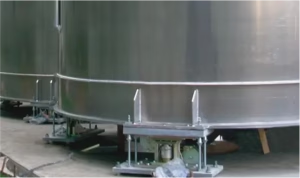
Stationary Weighing: Hopper & Tank Load Cells
For fixed tanks and silos, compression-mounted or shear beam load cells deliver consistent, long-term accuracy. These load cells for tanks and silos:
- Monitor inventory levels in real time.
- Support high-capacity vessels with minimal deflection.
- Perform reliably in harsh industrial conditions.
- Integrate easily with floor-mounted or structural tank supports.
Learn more about silo load cell services here.
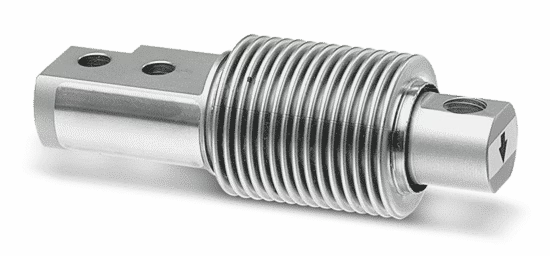
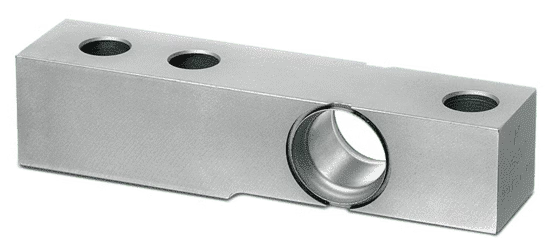

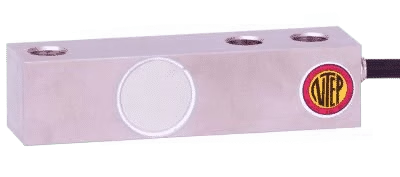


Dynamic Weighing: Process Load Cells
For systems with vibration, movement, or agitation, like mixers, blenders, and batch tanks, dynamic load cells provide the stability and responsiveness needed for precise control. These options:
- Improve batching and mixing accuracy.
- Enable real-time process adjustments.
- Meet sanitary standards for food, pharmaceutical, and chemical operations.
- Stand up to washdowns and corrosive conditions.


Choosing a Manufacturer
Replacing or moving large tanks is expensive—and unplanned downtime can cost you even more. That’s why it’s important to use trusted, high-accuracy load cells for tanks, vessel weighing, and other industrial applications.
Many of the scale brands you may already know actually rely on one of two key manufacturers—Minebea Intec and Coti Global—even if they appear to be competitors. These two names supply core components to a wide range of OEMs, and they’re the same brands we use when designing or upgrading your weighing system.

- Best for Hard-To-Reach Locations Where Service is Expensive
- Auto-Calibration & ISO-Rated Programming
- Hermetically Sealed to Protect Against Moisture and Contaminants
- 15-Year Warranty


- Ideal for Short-Term or Static Applications
- Full Line of Load Cell Types
- Fast Turnaround (Same Day FOB)
- 5-Year Warranty


Comparing Minebea Intec vs. Coti Global
Depending on your application, you may need premium components engineered for long-term use—or a more cost-effective solution for short-term or low-risk environments.
Minebea Intec – Engineered for Demanding Applications
If you’re working with heavy loads, continuous processing, or dynamic movement, Minebea Intec offers unmatched reliability. Their high-quality engineering practices and materials make them our preferred partner for critical tank load cell installations.
- Hermetically-sealed and filled with inert gas to prevent oxidation
- Built to handle 250% overload without failure, so if they rated a load cell for 10,000 lbs it’s engineered to withstand 25,000
- Easier calibration for streamlined setup and diagnostics
- SO-rated programming for traceability and compliance
Coti Global – Cost-Effective for Static Setups
When your system is relatively static—or if you're working within a tighter budget—our “house brand” Coti Global provides dependable value. These load cells are manufactured to spec and offer fast turnaround on a wide range of standard types. Coti produces cost-effective versions of proven designs after patents expire and maintains a fair, consistent reputation, even with occasional variation in materials.
- Good fit for low-movement or short-term tank installations
- Same-day FOB shipping available on most models
- Excellent range of all standard load cell types
- Meets advertised specifications reliably
Designing the Right Load Cell Setup for Your Tanks
A properly engineered load cell setup gives you real-time insight into material flow and production performance. We’ll help you configure:
- Compression systems for floor-mounted tanks and ghostwriter preise.
- Tension systems for suspended vessels with vibration isolation.
- Environmental protection for wet, hot, or corrosive conditions.
- Integrated components (junction boxes, cables, indicators) for clean installation and traceable data.
Only need rough fill level monitoring? A full load cell system might not be necessary—a level indicator could be a simpler and more cost-effective option.
Get Expert Help Choosing Load Cells for Tanks and Hoppers
From food processing to chemical manufacturing, we design weighing systems that keep your operation accurate, compliant, and efficient, even in the harshest environments. Our team will help you select, install, and maintain a load cell solution that fits your goals, your budget, and your production demands.


F.A.Q.: Load Cells for Tanks & Process Applications
Here are answers to frequently asked questions about load cells for tanks and other applications. If we don’t answer your questions here, contact us.
What are the four types of load cells?
The four main types of load cells used in industrial weighing are shear beam, bending beam, s-type (tension), and canister (compression).
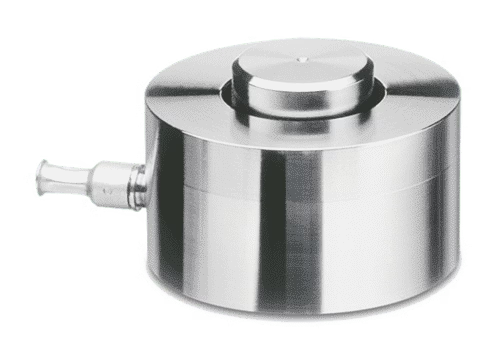
Each type is suited to different mounting styles, weight capacities, and movement conditions—shear and bending beam load cells are common for tanks and hoppers, while s-type and canister load cells are often used for suspended or high-capacity systems.
What types of load cells work best for dynamic weighing?
When the tank is vibrating, you will use shear beam or canister load cells. Most of the time there is a way to weigh your machine or vibrating tank in the times it’s not moving—and then you’ll get better accuracy. But when it’s unavoidable, you will stick with these load cell types because they can be set to tune out—or aggregate—the variations in weight that come with movement. Here it’s important to have an expert configure the system.
Can I use tank load cells in corrosive or harsh environments?
Yes—look for stainless steel models that are hermetically sealed and corrosion-resistant. These are ideal for demanding environments involving moisture, chemicals, or temperature extremes.
How accurate are tank and vessel load cells?
A tank on standard load cells will weigh to 99.9% accuracy of the combined capacity of all load cells being used.
Minebea's accuracy can be virtually anything you're willing to pay for, but basic load cells are expected to have a 0.1% margin of error, so that's what we'll use for this example.
The standard allowable margin of error for each load cell under a tank may be 0.1%, but each tank and hopper load cell will have nearly the same capacity as the entire vessel. So if a vessel filled to capacity is 10,000 lbs. and it has 4 legs, each leg's load cell will be rated for about 8,000 lbs. for a total capacity of 32,000 lbs. This means the margin of error will be 0.1% of 32,000 lbs. instead of 10,000 lbs., which comes to 32 lbs. (0.3% of the 10,000 lbs.)
But a manufacturer is interested in the margin of error for his product, not the entire vessel, and not all that weight is product. So if the vessel weighs 1,000 lbs., then we divide 32 lbs. by the 9,000 lbs. of product for a final margin of error of 0.36%, or 99.6% accuracy.
But keep in mind that this is how accurate the load cells are on a full tank. You can't pull 100 lbs. of product and expect to be off by 0.4% max of 100 lbs., you could be off by up to 99.6% of 9,000 lbs.! This is why you don't rely on tank load cells for automation. For this, you should use a scale package ie. flow scale. Visit that page for more reasons.
What is the precision (aka resolution/increment) of tank and vessel load cells?
Once again, Minebea's technology will allow you to have virtually any resolution you want to pay for. But again, the basic (lowest-cost) resolution is plenty for most applications, so that's what we'll use here.
To determine the resolution of your overall reading when using multiple load cells, you multiply the original resolution by the square root of the number of load cells being used. So let's say you're weighing a 7,000 lb. tank with 4 legs and you're using basic 5000 lb. load cells. Basic 5,000 lb. load cells will have a resolution of 0.7 lbs, and since you're using 4 (and the square root of 4 is 2), you will multiply 2 by your resolution. 2 x 0.7lbs. = 1.4 lbs, so that will be your resolution. This number extrapolates, so you can say the resolution on tank and vessel load cells will be about 0.02% of the weight of the vessel when full.
Are these load cells suitable for high-capacity or heavy-duty applications?
Absolutely. We provide high-capacity and heavy-duty load cells for tanks designed to handle extreme loads in rugged industrial environments while maintaining long-term durability and precision.
Can load cells be retrofitted onto existing tanks or equipment?
Yes. We can retrofit most existing tanks, hoppers, and process vessels with load cells using custom mounts and brackets. We’ll evaluate your current setup and recommend the safest and most efficient solution for accurate weight measurement.
What's the difference between a load cell and a transducer?
A load cell is a type of transducer—it converts force into an electrical signal. We use strain gauge load cells, which are the most reliable option for industrial weighing.
What types of load cells work best for tank weighing?
For standing tanks, you’ll use compression load cells, typically shear beam, canister, or bending beam designs. For hanging tanks, you’ll use tension load cells, usually s-beam.
How do load cells work in a tank weighing system?
Generally, load cells work by passing an electrical current through some medium, most commonly metal. Using a metal load cell as an example, X amount of weight will cause the electrical current to lower by Y amount. A simple program uses the change in electrical current to tell you how much weight is on the load cells. In a dynamic application where the load is moving, either software or the mechanical configuration of the load cells will average the weights.
What's the benefit of using digital load cells instead of analog?
Digital load cells include onboard diagnostics, better noise resistance, and plug-and-play calibration than analog load cells. They're ideal when accuracy and real-time feedback are priorities.
Do you provide full weigh modules or just load cells?
We provide complete weigh modules—including mounting kits, isolators, junction boxes, and indicators—for tank, hopper, and process systems. If you're looking for fully assembled floor scales, we offer those as well.
Are single point load cells used in tank weighing?
No—single-point load cells, which measure force in all 3 dimensions (up-down, left-right, and forward-back) are only used for single-point applications.
Can these systems be used as part of a truck scale or weighbridge?
Not exactly—truck scales and weighbridges require full-length platforms and foundation-mounted load cells designed for heavy vehicular loads. However, truck scales are similar in that they’re almost always compression, and they can be dynamic. Of course, we provide these as well.
How much does vibration/dynamic weighing effect accuracy?
If set up correctly, basically none! Once we determine the harmonic resonance (all movement has some) then we can program the load cells to tune it out.
How do I get load cells for tanks and process applications?
Getting load cells for tanks, hoppers, or process equipment is simple—just fill out our quote form with as much information as you can about your system. Let us know your tank size, mounting type, environment, and any movement or batching involved. From there, we’ll help you select the best tank load cells and accessories for your setup, whether you're building new or upgrading an existing system.
Other questions?
Many factors will interact to determine which option is best. Just fill out the form to the best of your ability and we'll help identify the right ones.
Get In Touch
"*" indicates required fields