
Bulk Material Handling Systems
ABM Equipment specializes in efficient, modular handling systems for most industries dealing with bulk dry solids. Currently on the forefront of ice cream, potato, pet food, and nutraceuticals, ABM has widespread experience with products from plastics to construction materials but specializes in food. ABM Equipment’s engineering division draws from a “deep bench” of application experience to efficiently provide systems that maximize productivity, improve safety, and minimize product degradation.
ABM Equipment specializes in efficient, modular handling systems for most industries dealing with bulk dry solids. Currently on the forefront of ice cream, potato, pet food, and nutraceuticals, ABM has widespread experience with products from plastics to construction materials but specializes in food. ABM Equipment’s engineering division draws from a “deep bench” of application experience to efficiently provide systems that maximize productivity, improve safety, and minimize product degradation.
ABM Equipment is a one-stop-shop for bulk material handling systems. We select equipment, engineer the system, and fabricate support structures, product transitions, and custom equipment. We then integrate the system, manage subcontractors (or act as one, if needed), and then service your equipment. We even provide scheduled maintenance and emergency service. Here we'll briefly cover the steps and products involved in system creation.
What Steps Are Involved
Process Engineering
The first step in turning bulk material handling equipment into a bulk material handling systems is process engineering. This is where an industry veteran looks at your product and goals from a birds-eye view. What types of equipment you need, what vendors you should be looking at, and what features you need are items that are too important and convoluted to figure out as a newbie. Bulk material handling is a big world and large companies have bought market-share for inferior equipment. They can look good and be everywhere, but they can be cheap. They can perform well, but their parts can be hard to get ahold of. They may have a new solution, but you may not want to count on them being around in 10 years when things are breaking down.
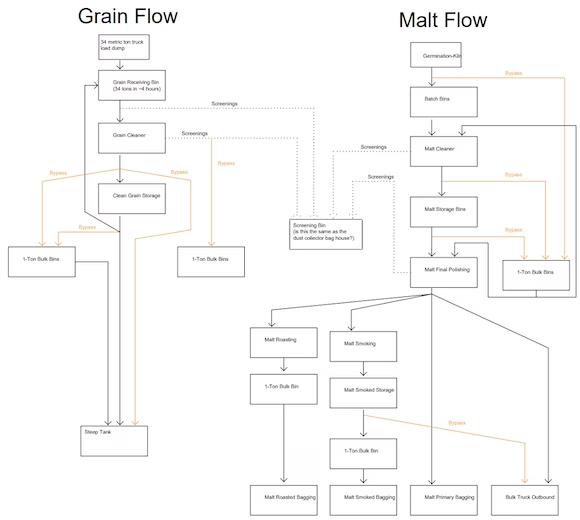
At this stage the experienced engineer will draw up a crude flow chart with the rest of the engineering team. Here they will establish which equipment will be high and which will be low, which resources—like water, gas, or waste—will be closest to which equipment, and which types of transitions and flow-assists will be used at which stage.

Mechanical Engineering
Next, comes the AutoCAD and Solidworks. The system is drawn up for the end goal of fabrication including system layout, support structures, and material transitions. Equipment drawings are also modified if needed so the product will be affected as desired.
Engineering will then ensure that no nearby equipment will accidently block access to pieces that will need removed for maintenance, and they will help you make the decisions on the inevitable trade-offs (or make these decisions for you). For example, let's say a wear part may be expected to need replacement every 6 months. The optimal drawing for system efficiency may orient equipment in a way that requires maintenance to remove bolts from nearby equipment to access the wear part. This will require the system to be taller or wider than originally desired to create room, product flow could be changed to allow equipment to rotate, or they may be able to find other equipment options to side-step the dilemma.
The customer is intimately involved in the process through this step.
Fabrication
Once the system is nailed down theoretically, engineering will work with fabrication to make it a reality. The 4 things we as integrators will be responsible for building are the following:
- Simpler Equipment: Bulk bag unloaders, frames, hoppers, etc.
- Support Structures: Mezzanines, equipment supports, etc.
- Transitions: Product gates, adapters between equipment, material flow guides, etc.
- Custom Equipment: This will vary depending on the integrator, but we make our own bag dump as discussed above, a few roller mills, scale packages, etc. We will also customize existing equipment by adding access doors, brackets, or by changing properties, like a conveyor's width, length, or guiderails.
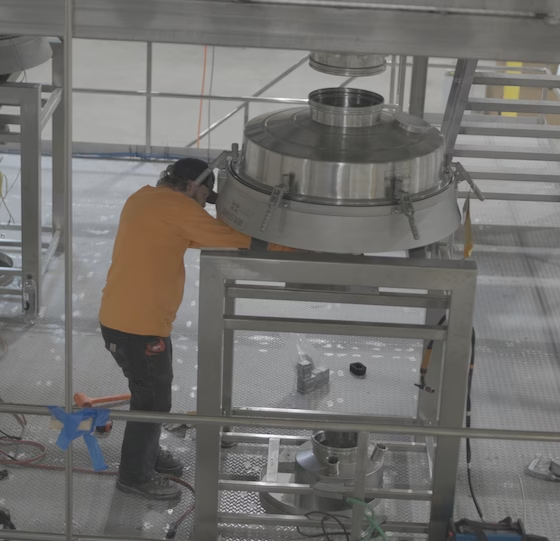
Smaller items will be built at our shop, but anything that is cheaper or impossible to build here can be built on-site. Some structures will be too big to fit in any door, so it will need to be built before the walls. Sometimes the difference in cost between shipping a finished item and the materials used to build it are so great that it's cheaper to rent a house and fabricate it at your facility.
Support
Once your system is up and running, your daily output will be worth more to you net than most pieces of equipment in that line. This is why the level of support for your equipment is one of the most important factors in a system's performance. To ensure that your system stays working, we provide a number of services.
- Equipment evaluation - This was mentioned during process engineering, but we should note here why it's so important to have someone who knows these OEMs to vet them. Some of the flashiest equipment with the best brand visibility has the worst documentation and parts availability.
- Spare parts - We help you sort through which spare parts you need to keep on-site, which ones you need to order on a schedule, and which ones can be left alone until failure because they won't cripple the line. We often handle the parts ordering as well.
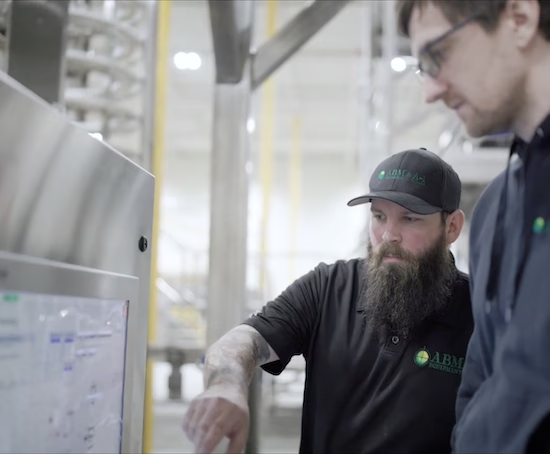
- Training - We stick around after the install to get your staff up to speed. The industry standard is to build the system, provide minimal training, and then make money on phone support when your staff doesn't know how to work it. We do not try to make money on the back end like this and train your staff thoroughly the first time.
- Maintenance and repair - As a general policy (with only a few exceptions) we service everything we sell so you don't have to rely on the OEM. We provide 24/7/365 service as well as preventative maintenance contracts to reduce the risk of any down-time.
What Equipment is Involved
Every bulk material handling system will involve a closed conveying line being fed by bulk storage as well as ways to add smaller quantities of material into the line.
Silos
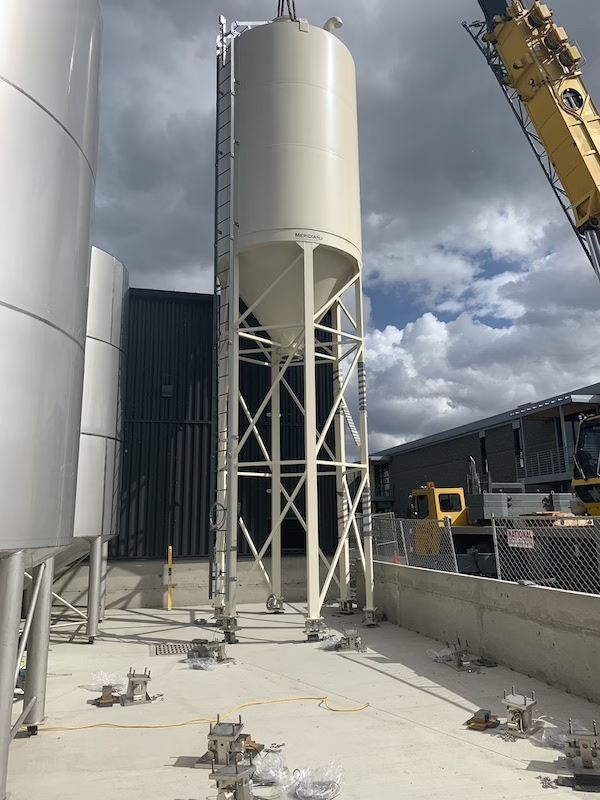
Silos store anywhere between 2 to 200 thousand pounds and the type you need is usually obvious. Smooth-wall (single-piece) silos are more expensive but are much more secure, so you will use smooth-wall silos if any of the below is true:
- The silo needs to last
- The product is perishable (especially important if the silo is outside)
- The product bridges so much that the corrugation could interfere
- You will fill with pneumatic lines (expansion and contraction caused by pressure changes rapidly ages corrugated silos)
You will use corrugated silos when A, none of the items above are true and B, your capital is worth more to you now than it will be in the future.
But sometimes your material will be right on the line; kind of perishable—but not really, likes to bridge—but not that much, could be blown in—but doesn't have to be. If you're using a material that fits in both camps (grain is a common example) we have a much more thorough writeup on that here.
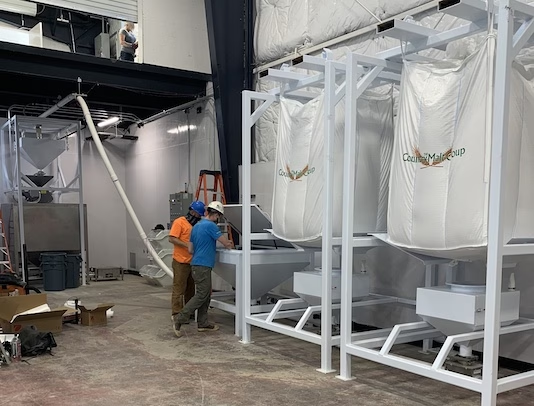
Bulk Bag Unloaders
Standard bulk bag size for a product will depend on its weight—ranging anywhere from 35 to 55" length and width, with lengths up to about 65"—but the most common size we see is around 42" x 42" W and 62" L. Our standard bulk bag unloaders have clearances of 56" wide/deep and 65" long, but they can be made in any dimension needed.
Bag Break Stations
Bag breaks allow workers to add non-bulk materials into the conveying line, and there are a few options for configuration. Some go straight into the tubular drag or pneumatic line and some go through a sifter first so that oversized particles can be fed into milling. They can be integrated into a central dust collection system or have a localized dust collector on the unit. ABM Equipment's Auto-Pulse Bag Dump Station is one of the latter and has a few extra benefits you can read about here.
Work Bins
Work bins stage materials, either so they are accessible to "work with", or to alleviate pressure between automated and batch processes. For example, if you have a flour mill generating 300 lbs. an hour and a mixer that needs 150 lbs. of flour every half hour, you don't want to wait until the mixer needs the flour to start milling it. A work bin will stage the product so the mill can operate continuously and and the mixer will always be fed.
Conveyors
Conveying is a massive topic but know that whether you want to simply move product, separate it, or accumulate it, that's what we do. Washdown, tool-less disassembly, hygienic, or any other configuration needed, we provide it. Click the word "conveyor" above to see different options. On each page you can see the benefits and drawbacks of each.
Feeders
Feeders precisely meter materials into a process and primarily come in screw or vibratory configurations. Volumetric feeders use volume (a turning screw at a certain rate will move a specific volume of material) or loss-in-weight (load cells will be used to determine how much less the feeder weighs after dispersement) to measure how much product was dispensed. This is called volumetric or gravimetric. This is done for recipe accuracy. Weighbelts are conveyors on load cells, which can be used to feed crudely.
Ancillary Equipment
When using augers or tubular drag conveyors to pull product from storage, butterfly valves or knife gates are fine because there is no pressure differential. (But we recommend using our proprietary, leak-free knife gates to eliminate dust.) When using pneumatics, we will need to use a rotary valve/airlock to manage the pressure differentials.
Dust collection to improve the air and safety of the workplace is available in cyclone, cartridge, or baghouse configurations for any process. Throughout your process you may want tanks or machinery on load cells for inventory's sake, but for purposes of automation you should always use a scale package, or what others call a flow scale.
We provide various options for process controls and custom programming for PLCs and HMIs. We also have our own in-house reporting, analytics, and control software, DSO Sentinel.
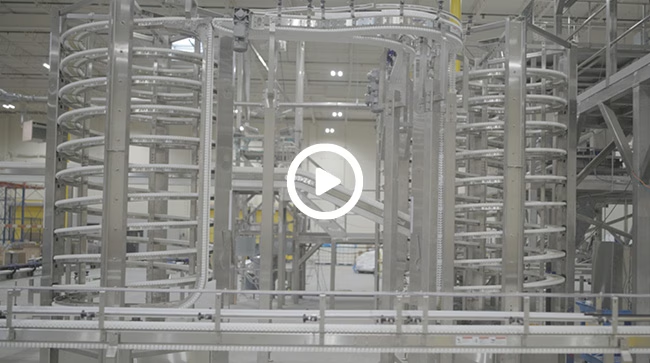
Video showing bulk material handling system ↑
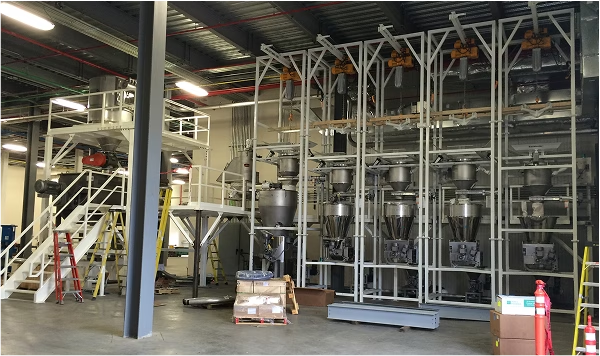
What is a bulk material handling system?
Bulk material handling systems are the combination of bulk material handling equipment, and automate the process of handling loose materials. It is mostly before but also works hand-in-hand with the processing equipment, taking material from process to process.
Only storage, conveyance, feeding, and staging are truly tenets of material handling because their purpose is to move or hold material. Sifters, screeners, dust collectors, load cells, and magnets are often called “material handling equipment” because they are often present, but these are supporting pieces that are made necessary by many types of equipment. They are most common during the processing stage (that’s where most of them live on our site), but we included their links above anyway.
What are the lead times on these systems?
To get the lead time you need to combine those of equipment, engineering, and permitting. Smaller jobs like breweries can be out of engineering in a day, and larger food processing plants can take up to 6 months of engineering time depending on the number of revisions. Equipment lead times will be anywhere between 1 and 9 months, and fabrication can take between 1 day (for a brewery) and 4 months for a large job. Integration can also be between 1 day and 6 months. Tell us about your project to get usable numbers.
What's the benefit of a bulk material handling system?
The purpose is to improve the bottom line by 1, automating out manual labor, and 2, allowing producers to save on ingredients by buying in bulk.
Why should I choose ABM Equipment?
Because you're looking for "bulk material handling", you're looking for dry bulk solids, and that's our specialty. You don't have to get a quote from only us, but be sure to get one from us so we can convey the unique value-adds we will bring to your project.