
Liquid X-Ray
The liquid X-ray model (pipeline from Eagle) is used for all types of liquid products from soups and slurries to ground meat. It employs a flow meter to improve the image consistency—which makes contaminants easier to find—and a diverter valve to reject contaminated segments of product.
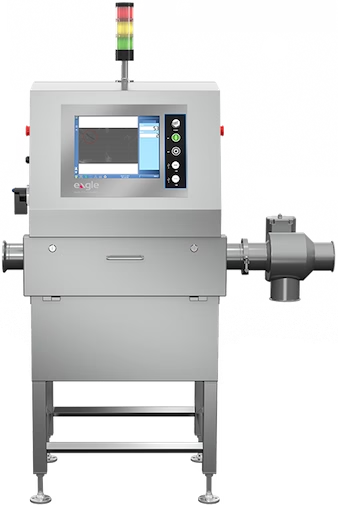
The liquid x-ray inspection system is designed to specifically address the unique requirements posed by products flowing through a pipe, as well as helping manufacturers comply with stringent HACCP protocols and food safety requirements.
The overall design promotes systematic product flow and delivers optimal detection of contaminants by using active product tracking, while reducing the amount of product rejected. With breakthrough PXT™ dual energy detector, processors can obtain much higher resolution images than previously possible. This results in improved detection of smaller bones and contaminants with fewer false rejects increasing productivity while reducing unnecessary and costly rework.
The liquid x-ray inspection manifold design provides a uniform area to maximize detection capabilities at 2.5”, 3” and 4” pipe diameters.
The liquid x-ray machine is constructed using durable stainless steel, with a IP69 ingress protection for maximum environmental protection suitable for most facilities. This rugged construction is combined with easy front access for fast maintenance and cleaning, making the liquid model the right choice for high performance inspection applications.
The ABM Advantage
Applications such as ground meat, slurries, liquids and other raw food ingredients can be challenging for standard metal detector systems to detect contaminants that are not ferrous metals and do not have magnetic properties. Eagle’s proven x-ray systems overcome these challenges with easy-to-use detection algorithms resident within our imaging software that discriminates contaminants by density. This enables the liquid x-ray inspection system to clearly identify foreign body contaminants contained within the product flow for a broader range of detection for either metal, bone, stone, glass or dense materials.
Reject Mechanisms
A 3-way automatic reject valve ensures contaminants are removed from the production process and keeps the removal of good product to a minimum. This not only cuts the risk of a substandard product reaching end consumers, but also protects the downstream processing equipment and minimizes product waste, which protects profits and enhances efficiency.
X-ray Inspection System
The Liquid Pipeline X-ray inspects and rejects piped product prior to packaging or processing. This inspection leads to fewer wasted packaging materials, creates less rework and greatly reduces product loss caused by the removal of contaminants after packaging. By removing contaminants earlier in the process, it decreases the potential for expensive downtime events caused by contaminants that damage downstream equipment, such as grinders.
Typical applications include:
- Ground meat (beef, pork, poultry)
- Whole muscle such as chicken breasts
- Unshelled clams
- Slurries, soups and sauces
- Ice cream
- Baby food
- Fruit purees and jams
Software and Reports
Eagle’s SimulTask PRO imaging software is available in 19 different user interface languages and is included as a standard feature for the X-ray machines for liquids.
Additional features include full product imaging, on-screen diagnostics and safety system status. DSO Sentinel allows convenient review of production statistics for rejected and manually-saved images through its user interface. Information can be viewed by other computers on the network, and automated reports are sent to production managers' computers at the end of each shift or day. All our liquid X-ray machines are network capable, allowing remote access by expert technicians if needed to quickly diagnose and often correct issues without dispatching on-site service.
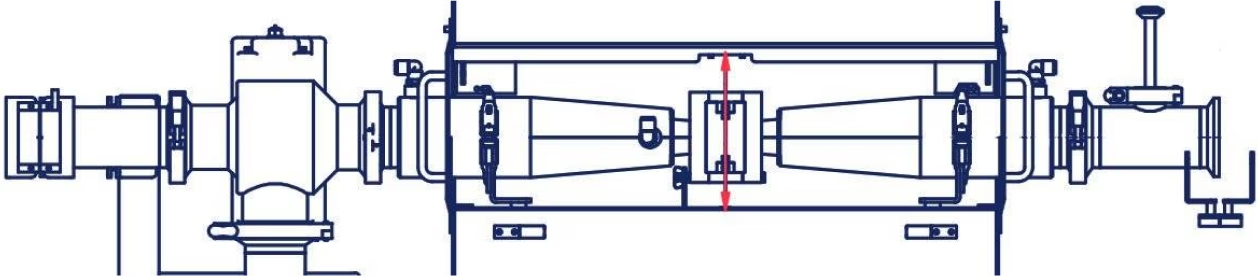
Figure 1: Liquid X-ray manifold area, front open cabinet view
Liquid X-ray Features and Benefits
- PXT™ detection technology combined with Eagle’s SimulTask™ PRO operating system delivers unparalleled contaminant and bone detection
- Unique active product tracking ensures accurate contaminant removal and reduces waste.
- The rectangular manifold inspection area promotes uniformity of inspection and maximizes contaminant
detection. - Excellent reject accuracy due to dynamic flow speed adaptation.
- SimulTask™ PRO image processing software provides advanced image analysis, is easy-to-use and
delivers high performance inspection results. - Efficient cleaning and maintenance for maximum uptime.
- CAT 3/PLd safety circuit with system status visualization is included as a standard feature.
- TraceServer™ option manages critical inspection data remotely on a PC or Network database
Beam Geometry Diagram
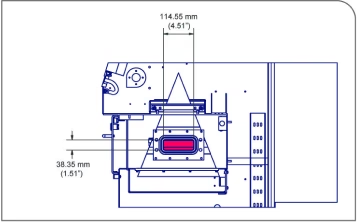
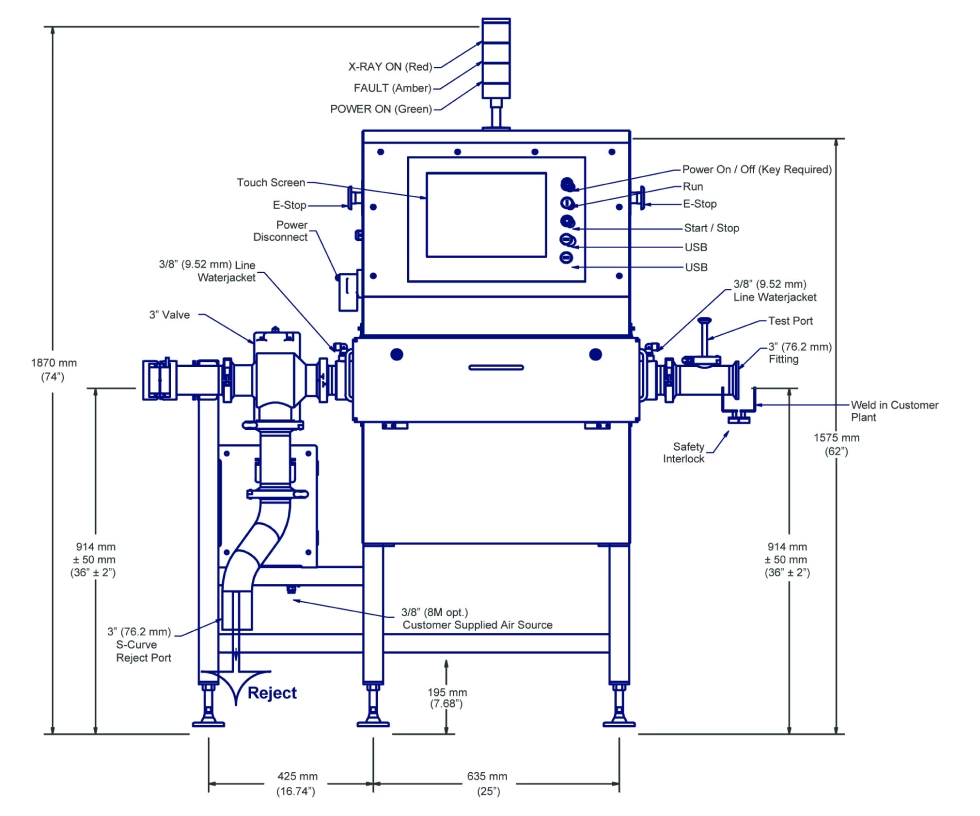
Figure 2: Liquid X-ray with rejector option typical dimensions
Specifications
| Model | Liquid X-ray |
|---|---|
| Pipe Diameter (OD) |
2.5”, 3”, 4”; Q-line fittings standard for 2.5” and 3”, Tri-clamp fitting standard on 4”; others available upon custom request
|
| Pipeline Height | Available in line heights from 29” (737 mm) to 55” (1397 mm); special heights available upon request |
| Maximum Product Speed | 30 meters per minute (65 feet per minute); recommended pipeline pressure 10 Bar (145 PSI) maximum pressure 15 Bar (217 PSI) |
| X-ray Power | 70kV @ 3mA maximum, adjustable to optimize inspection performance for each product set-up |
| X-ray Type & Emissions | Single beam; x-ray emissions <1µSv/h>; compliant to 21 CFR 1020.40, 21 CFR 179.21, EUROTAM EU nationalized standards |
| Detector Resolution | 0.4 mm, 0.8 mm and dual energy PXT™ |
| Display & Operating System | 15” TFT color touch screen, 250GB memory, Windows 10 Embedded 8, Eagle SimulTask™ PRO imaging software available in 19 different user interface languages |
| Safety | (2) E-stops, LTO main disconnect, Category 3 (EN954), PLd (EN13849) safety circuit with system visualization via machine user interface. A Hazard Based Risk Assessment compliant with ISO EN 12100:2010 is available. |
| Communications | (2) USB 2.0 ports, (2) Ethernet 10Mbit, 100Mbit, 1Gbit Base-T/100 mbps port, (1) RS232 serial port |
| I/O | (4) Input signals, (4) reject output signals, (5) output signals; 5 PLC monitoring signals for: reject detect, system processing, system calibrating, fault condition, x-rays on |
| I/O | I/O board with up to (4) input signals, (4) reject output signals, (5) PLC monitoring signals:reject detect, system processing, system calibrating, fault condition, x-rays on |
| Ingress Protection & Finish | IP69 ingress protected control cabinet; IP66 externally mounted air conditioner (IP69 Shrouded AC Optional); 304 stainless steel bead blasted enclosure |
| Operating Range | 0°C to 40°C (32°F to 104°F) 25% to 90% relative humidity non-condensing |
| Power Requirements | 230 VAC, +10/-10%, Single Phase 50/60 Hz, 16 Amp fused, single phase |
| System Cooling | 4000 BTU (1.1kW) wash-down capable air conditioner |
| Air Requirements | 5.5 bar (80 psi), 3/8” (8mm opt.) line, dry & filtered when supplied with rejecter |
| Water Specification | Plant water supply 2 gpm (7.61 liter/min) when waterjacket option is used |
| Reject | 24VDC Signal; 3-way ball valve reject, tri-clamp fittings; optional contaminant catch ports available upon request |
| Options & Accessories | TraceServer™ software, low air pressure sensor, waterjacket for applications containing fat, general purpose water chiller |
| Remote Diagnostics | Radmin and TeamViewer service tools supplied as standard for remote machine diagnostics and product set-up services |