
Top 5 Mistakes to avoid when using tabletop mills
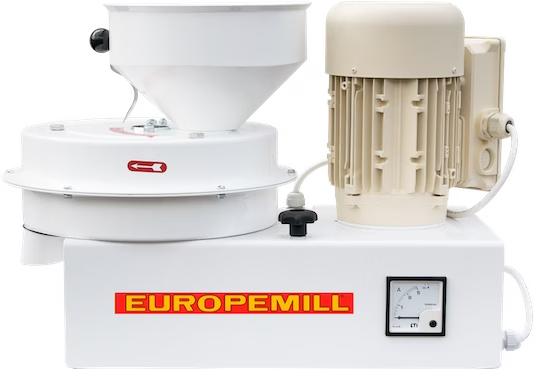
A tabletop flour mill will save you money and improve your products by allowing you to order grains in bulk and bake your flour immediately after milling. But getting the most out of your investment isn’t always intuitive. These are five of the most common mistakes operators make with tabletop flour mills.
1. Using the Incorrect Grains
You should use the right products in the right mill. Like all disc mills, tabletop mills can come in either stone or steel discs, either in a vertical or horizontal configuration, for a total of 4 variation possibilities. Examples are below, but generally you want to use stone for dry grains because they will reduce temperature (retaining nutrients) and you don’t have to worry about oils. You want to use steel discs for oily materials like seeds, because you will need to clean the discs between each type of product.
Whether stone or steel, you will use horizontal discs when you want a finer, more consistent grind because products will stay between the discs for longer. Use a vertical configuration when fineness/consistency doesn’t much matter and you just want high throughput for the dollar.
Most common product and mill configuration pairings
Stone horizontal mills – Coffee and grains like wheat, oats, and barley when milling finely
Stone vertical mills – Coffee, spices, and cereal grains like oats when milling coarsely
Steel horizontal mills (Uncommon) – Seeds that need milled finely
Steel vertical mills – Spices, peas, corn meal, oily seeds when milling coarsely
2. Skipping Grain Cleaning
If you plan on putting grain into your mill, you need to clean it first. Uncleaned or dirty grain will introduce stones and debris into the burrs, and—depending on your supplier—sometimes rocks. The burrs can either go dull quickly or stop working altogether.
Another potential issue is contamination. Dirty grains leave behind unwanted debris in the mill. When you mill the flour, it can pick up traces of the debris. In this way, your end product could pick up a taste of dirt, bitter weed, or anything else that got ground into the pores.
To prevent the hassle arising from dirty grains, inspect and rinse them before milling. While this is true of all grains, it’s especially true for bulk grain or grains that have been stored for a long time.
3. Overheating the Tabletop Flour Mill
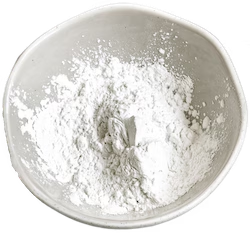
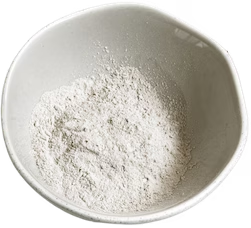
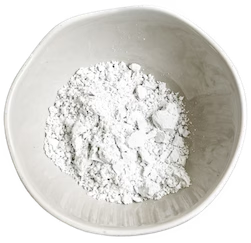
Your mill can handle a lot of work, but too much use will risk 1, the electric motor overheating, and 2, the stone discs overheating which will affect the nutritional value of the grain. Heat impacts the final product’s nutritional content and flavor.
Generally, you don’t want to let the mill run when you’re not using it or exceed the max run-time given by the manufacturer.
All of the following are common causes of overheating a flour mill:
Excessive Load
A mill can only work as hard as it’s designed to work. If you push it past its limit by making it grind too hard of a material or too fine of a material, the mill will generate too much heat, degrading the product and the mill. Avoid overloading by using the appropriate grind setting and metering the grain into the stones properly
Poor Ventilation
While time passes, dust and debris can block the air flow to the motor. As a result, the heat dissipates and there’s a greater risk of overheating. Make sure the air flow around the motor is clear and unobstructed
Malfunctioning Cooling fan
If your motor uses a cooling fan to prevent overheating, you need to ensure that it isn’t blocked. Without a working fan, the mill could experience high temperatures. So check the cooling fan occasionally and clean it when needed.
4. Having the Incorrect Grind Settings
One of the more common mistakes by operators is to use the wrong grind size. With the wrong size, you could cause any of the following issues:
- Mill jamming
- Excessive friction between discs and inside the motor
- Wrong consistency of flour
In some types of mills, you can adjust the stones and feed rate while you run the motor. However, there are other types of mills that require you to turn off the motor before adjusting the grind setting. You should make sure to follow the directions in the manual.
If you can’t change the grind while you run the motor, do a few test batches and figure out the best grind setting. Start the motor, set the stones to the grind you want, and then meter it in by turning the hopper. Once you get started, keep that setting the same until you finish.
5. Neglecting Cleaning and Maintenance
Whether you clean between each product, at the end of every day, or more seldom, just make sure the mill doesn’t go long periods of time without cleaning so it doesn’t attract mold, insects, or rodents. Each mill will have its own instructions, but usually it just involves brushing flour out of it and allowing the whole thing to air dry.
Although a tabletop flour mill is a simple piece of equipment, it could streamline your operation and save you money. By avoiding the mistakes above, you can make the most of your mill and prevent the need for frequent repairs. If you need a reliable tabletop flour mill, check out our selection of products.
Disc Mills

Commercial Flour Mill
Home » Processing Equipment » Mills » Disc Mills A sturdy, long-lasting grain…
Cereal Grain Mill
Home » Processing Equipment » Mills » Disc Mills Get Quote Operating Principle A…
Professional Tabletop Flour Mill
Throughputs 66 fine lbs./hr., 165 course lbs./hr. Made In Denmark/EU Video of Mill Being…

Spice Mill
Throughput 220–1,433 lbs./hr. depending on millstone size Motor 2-10 HP (Depending On Millstone…