
Dairy 3A Screeners
3-A sanitary vibratory screeners are the best option for removing impurities from milk, cream, cheese, and other dairy products because the vibration reduces pooling and allows more flow-through per square inch. Forced screening is not recommended as screen breakages are the second most common source of metal contaminants in dairy products (more on this in the Costco section below). As with most equipment we sell, these gap-free screeners have been optimized for the application and are available in sizes from 24 to 60 inches in diameter.
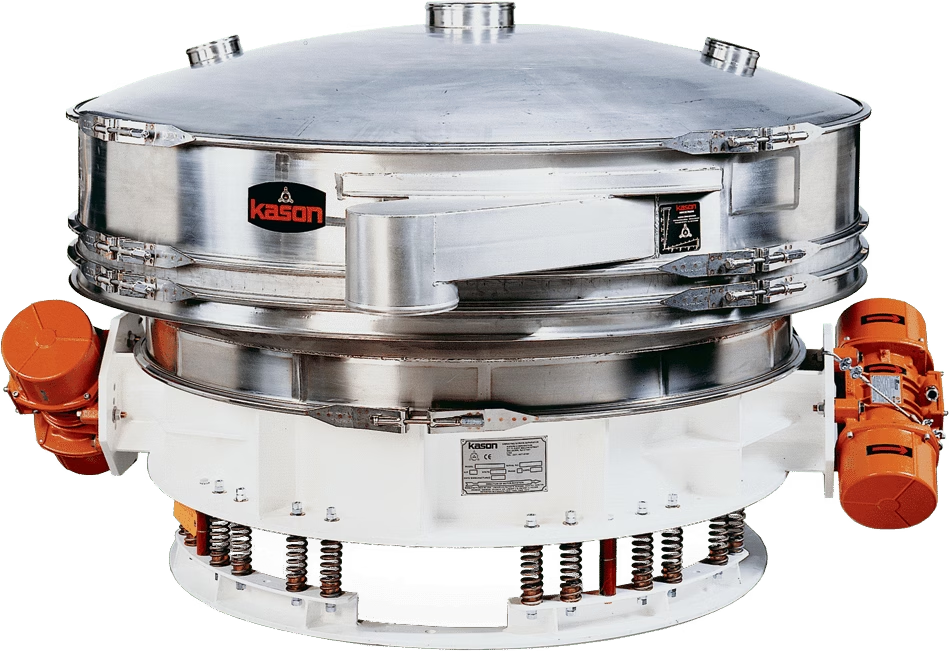
Designed to scalp oversize particles as small as 38 microns (400 mesh) from dry bulk materials or solids-laden slurries, this unit can be disassembled without any tools for rapid sanitizing. The interlocking flange of the screen frame completely encompasses the support ring of the screen, allowing the wire mesh of the screen to extend entirely to the interior walls of the frame, eliminating the gap found in conventional screeners where materials could accumulate.
The sanitary, gap-free design can eliminate contamination caused by bacterial growth while also improving sanitizing efficiency, making it suitable for food, dairy, and pharmaceutical products. The screens are mounted on support rings using FDA-approved epoxy and sealed with FDA-approved gasket material. They can also be provided with a mesh-tolerance certificate. The wire mesh screening material is available in 304, 316, and "magnetic" 400-series stainless steel that can be captured by a downstream magnet if broken. They can also be equipped with either single or twin imbalanced-weight gyratory motors and can be supplied with a dust-tight cover.
Low Profile Option
The low-profile option, also called a check-screener, uses two unbalanced-weight gyratory motors located on opposing exterior sidewalls instead of a single motor positioned below the screening chamber, which greatly reduces the minimum height requirement. This low-profile configuration allows on-size particles to pass quickly through the screen in a vertical discharge path at higher rates than circular screeners that have centrally mounted gyratory motors and horizontal discharge paths. Check-screeners do not have a discharge for sorting and is only for catching contaminants, so any contaminants/oversize material must be manually removed or eliminated using a vacuum.
A Word About Screeners and Costco's X-Ray Exception
Although untrue, Costco believes that x-ray cannot find metals in dairy products, so they provided an exception in their universal x-ray requirements for suppliers. On these grounds they said dairy producers could use screeners instead of x-ray. If satisfying Costco's requirements is your primary goal, these vibratory screeners are the safest to use. But if foreign material contamination is a high priority for you, we recommend using x-ray anyway, because broken screens are the largest cause of metal contaminants in dairy products, after mixers. If the cost of x-ray is prohibitive for your company, a cheaper precaution is to use a centrifugal sifter with a mesh screen. But either way, the mesh gap needs to be smaller than the maximum contaminant size.
If you have any questions or would like a quote, simply fill out the form below or give us a call!
Related Equipment
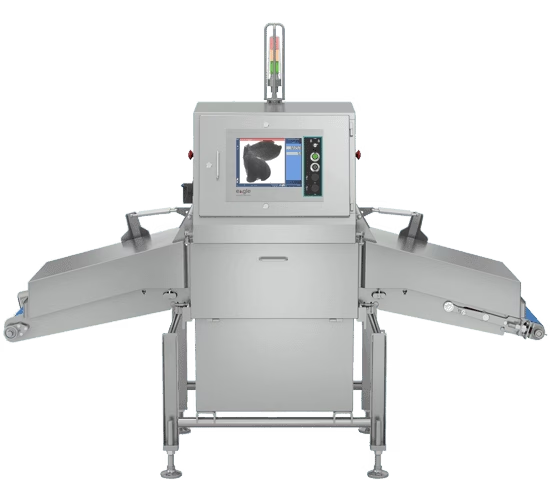
Loose Meat X-Ray
The X-ray systems for inspecting raw, unpackaged meat use angled “arms” to shield users from X-rays without touching the meat. It is most popular for pre-processed fish and chicken because it does not measure fat content but is compatible with PXT for finding small bones that were not discoverable a few years ago. The unmatched performance and comprehensive hygienic features make the RMI models (400 & 540) from Eagle the industry’s best solution for loose meat.
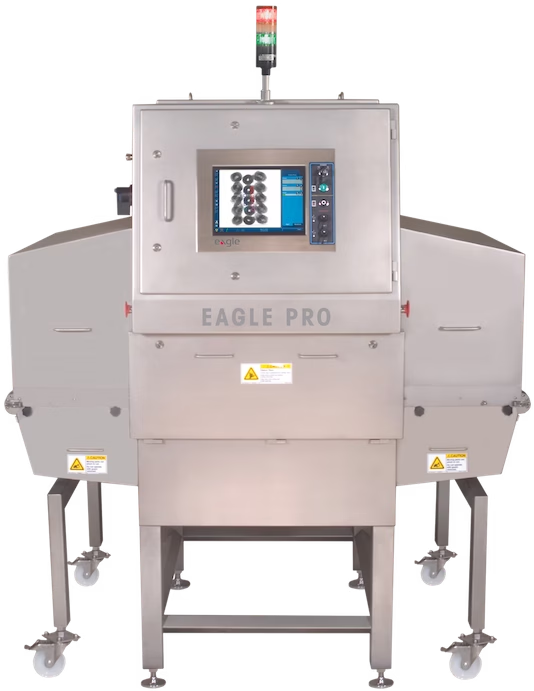
Case & Multi-Lane X-Ray
The model for X-raying cases of product delivers superior contaminant detection and other quality checks for large packages. It can detect product voids, missing products, package damage, case weight, item weight, and fill level of the cases or individual products within it. Though larger, it can detect small contaminants just as effectively as smaller units, which is why they are often repurposed to accept multiple lines of smaller products so processors can buy 1 bigger machine instead of multiple smaller ones. The corresponding model is the 720 from Eagle.
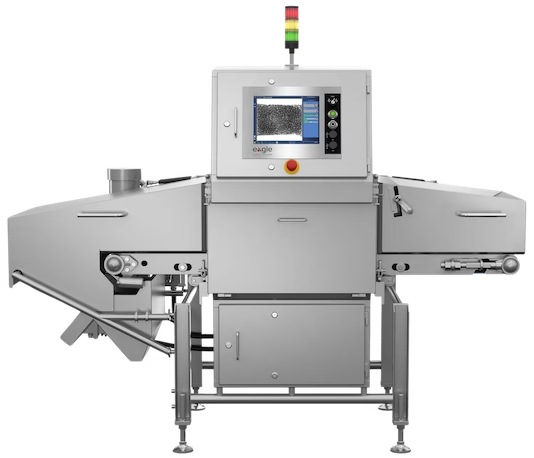
Bulk Food X-Ray
The bulk food x-ray machine features a number of infeed options to accommodate different foods and process configurations. It delivers a robust construction that Eagle is famous for, with full sanitary wash-down available. It is available in both the legacy and PXT models for either lowest total-cost-of ownership (if you’re trying to just check the X-ray box) or if you want to find everything the modern industry is capable of. The corresponding model is the bulk 540.
Food Bar X-Ray
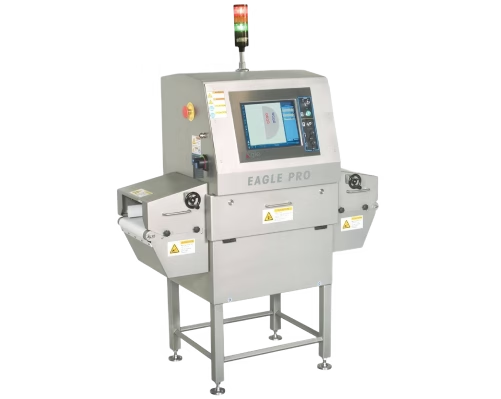
Our smallest x-ray machine is used for the smallest individually-packaged product such as candies, hydration packs, and small nutraceuticals, but most commonly for food bars such as candy, breakfast, and protein bars. The model used for this is the Pack 240 Pro from Eagle.